Thursday, 11 January 2018

20 years ago today, the World Wide Web opened to the public

The World Wide Web has its foundation in work that Berners-Lee did in the 1980s at CERN, the European Organization for Nuclear Research. He had been looking for a way for physicists to share information around the world without all using the same types of hardware and software. This culminated in his 1989 paper proposing ‘A large hypertext database with typed links’.
While the initial proposal failed to gain much momentum within CERN, it was later expanded into a more concrete document proposing a World Wide Web of documents, connected via hypertext links. World Wide Web was adopted as the project’s name following rejected possibilities such as ‘The Mine of Information’ and ‘The Information Mesh‘. The May 1990 proposal described the concept of the Web as thus:
HyperText is a way to link and access information of various kinds as a web of nodes in which the user can browse at will. Potentially, HyperText provides a single user-interface to many large classes of stored information such as reports, notes, data-bases, computer documentation and on-line systems help. We propose the implementation of a simple scheme to incorporate several different servers of machine-stored information already available at CERN, including an analysis of the requirements for information access needs by experiments.
The document envisaged the Web as being used for a variety of purposes, such as “document registration, on-line help, project documentation, news schemes and so on.” However, British Berners-Lee and his collaborator Robert Cailliau, a Belgian engineer and computer scientist, had the foresight to avoid being too specific about its potential uses.
In 1990, working on a computer built by NeXT, the firm Steve Jobs launched after being pushed out of Apple in the mid-80s, Berners-Lee developed the first Web browser software called, fittingly, WorldWideWeb. By the end of that year he had a working prototype of the Web running on a server at CERN.
Here’s what that very first browser looked like running on the NeXTStep operating system:
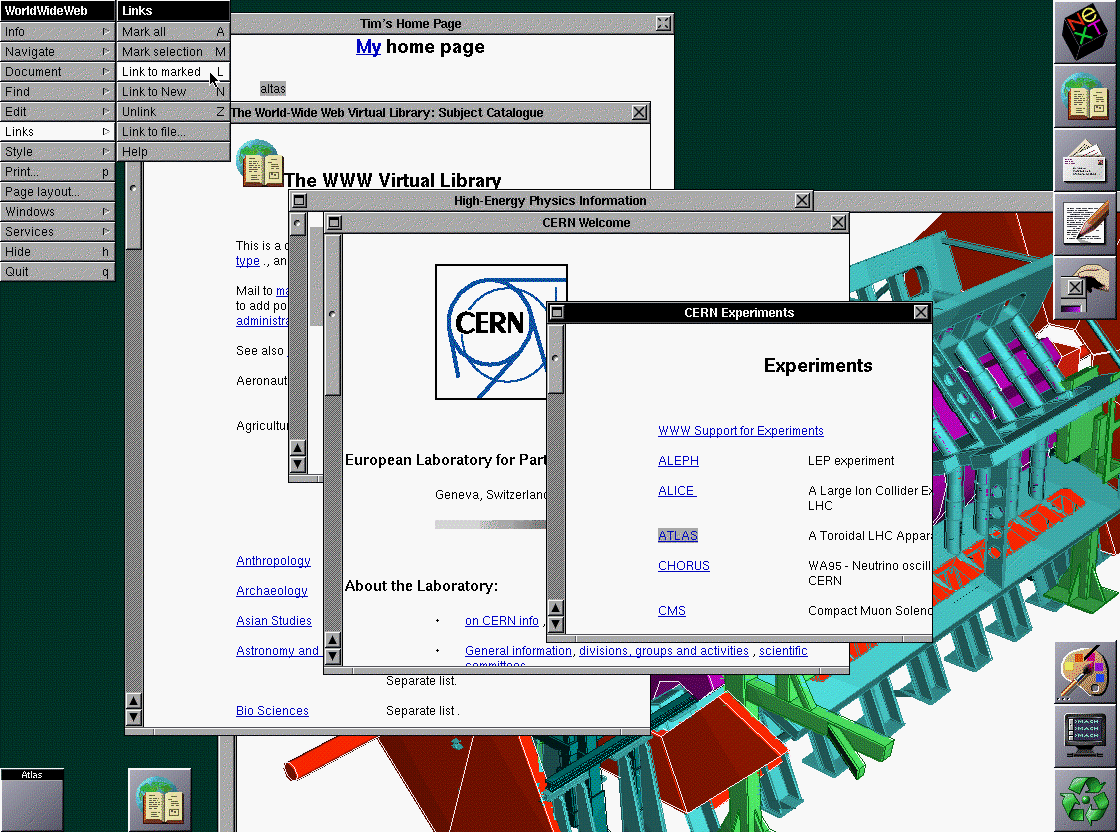
On 6 August 1991, the World Wide Web went live to the world. There was no fanfare in the global press. In fact, most people around the world didn’t even know what the Internet was. Even if they did, the revolution the Web ushered in was still but a twinkle in Tim Berners-Lee’s eye. Instead, the launch was marked by way of a short post from Berners-Lee on the alt.hypertext newsgroup, which is archived to this day on Google Groups.
The WWW project merges the techniques of information retrieval and hypertext to make an easy but powerful global information system.
The project started with the philosophy that much academic information should be freely available to anyone. It aims to allow information sharing within internationally dispersed teams, and the dissemination of information by support groups.
The post explained how to download the browser and suggested users begin by trying Berners-Lee’s first public Web page, at http://info.cern.ch/hypertext/WWW/TheProject.html.
Although that page is no longer available, a later version from the following year is archived here. It acted as a beginner’s guide to this new technology.
The evolution of the Web
From here on, things began developing rapidly for the Web. The first image was uploaded in 1992, with Berners-Lee choosing a picture of French parodic rock group Les Horribles Cernettes.

In 1993, it was announced by CERN that the World Wide Web was free for everyone to use and develop, with no fees payable – a key factor in the transformational impact it would soon have on the world.
While a number of browser applications were developed during the first two years of the Web, it was Mosaic which arguably had the most impact. It was launched in 1993 and by the end of that year was available for Unix, the Commodore Amiga, Windowsand Mac OS. The first browser to be freely available and accessible to the public, it inspired the birth of the first commercial browser, Netscape Navigator, while Mosaic’s technology went on to form the basis of Microsoft’s Internet Explorer.
The growth of easy-to-use Web browsers coincided with the growth of the commercial ISP business, with companies like Compuserve bringing increasing numbers of people from outside the scientific community on to the Web – and that was the start of the Web we know today.
What was initially a network of static HTML documents has become a constantly changing and evolving information organism, powered by a wide range of technologies, from database systems like PHP and ASP that can display data dynamically, to streaming media and pages that can be updated in real-time. Plugins like Flash have expanded our expectations of what the Web can offer, while HTML itself has evolved to the point where its latest version can handle video natively.
The Web has become a part of our everyday lives – something we access at home, on the move, on our phones and on TV. It’s changed the way we communicate and has been a key factor in the way the Internet has transformed the global economy and societies around the world. Sir Tim Berners-Lee has earned his knighthood a thousand times over, and the decision of CERN to make the Web completely open has been perhaps its greatest gift to the world.
The future of the Web
So, where does the Web go from here? Where will it be in twenty more years? The Semantic Web will see metadata, designed to be read by machines rather than humans, become a more important part of the online experience. Tim Berners-Lee coined this term, describing it as “A web of data that can be processed directly and indirectly by machines,” – a ‘giant global graph’ of linked data which will allow apps to automatically create new meaning from all the information out there.
This 14-minute video by Kate Ray is a great introduction to the concept of the Semantic Web.
Meanwhile, while not strictly ‘the Web’, the Internet of Things will allow physical objects to transmit data about themselves and their surroundings, bringing more information about the real world into the online realm. Imagine getting precise, live traffic data from all the local roads; trains that tell your smartphone that they’re full before they arrive; flowers that email you when they need watering; maybe even implants in your body that give you real-time updates about your health that feed into a secure online ‘locker’ of your personal data. All this and more is possible with the Internet of Things, helping to transform what we expect from the Web and the Internet.
We can’t predict accurately everything that the future will hold for the Web, but whatever happens, it won’t stand still. Here’s to the next twenty years.
Happy twentieth birthday, World Wide Web!
Read next: What will the Web be like in 20 years?
A BRIEF GUIDE TO THE HISTORY OF THE INTERNET
WHAT IS THE INTERNET ?


The Internet is a worldwide system of interconnected computer networks that use the TCP/IP set of network protocols to reach billions of users. The Internet began as a U.S Department of Defense network to link scientists and university professors around the world.
A network of networks, today, the Internet serves as a global data communications system that links millions of private, public, academic and business networks via an international telecommunications backbone that consists of various electronic and optical networking technologies.
Decentralized by design, no one owns the Internet and it has no central governing authority. As a creation of the Defense Department for sharing research data, this lack of centralization was intentional to make it less vulnerable to wartime or terrorist attacks.
The terms "Internet" and "World Wide Web" are often used interchangeably; however, the Internet and World Wide Web are not one and the same.
The Internet is a vast hardware and software infrastructure that enables computer interconnectivity. The Web, on the other hand, is a massive hypermedia database - a myriad collection of documents and other resources interconnected by hyperlinks. Imagine the World Wide Web as the platform which allows one to navigate the Internet with the use of a browser such as Google Chrome or Mozilla Firefox.
Follow the Internet Timeline below to see how the Internet has evolved over the years and take a glance at what lies ahead in the future as the Internet continues to change the world we live in.
INTERNET TIMELINE
1957 – USSR launches Sputnik into space. In response, the USA creates the Advanced Research Projects Agency (ARPA) with the mission of becoming the leading force in science and new technologies.
1962 – J.C.R. Licklider of MIT proposes the concept of a “Galactic Network.” For the first time ideas about a global network of computers are introduced. J.C.R. Licklider is later chosen to head ARPA's research efforts.
1962 - Paul Baran, a member of the RAND Corporation, determines a way for the Air Force to control bombers and missiles in case of a nuclear event. His results call for a decentralized network comprised of packet switches.
1968 - ARPA contracts out work to BBN. BBN is called upon to build the first switch.
1969 – RPANET created - BBN creates the first switched network by linking four different nodes in California and Utah; one at the University of Utah, one at the University of California at Santa Barbara, one at Stanford and one at the University of California at Los Angeles.
1972 - Ray Tomlinson working for BBN creates the first program devoted to email.
1972 - ARPA officially changes its name to DARPA Defense Advanced Research Projects Agency.
1972 - Network Control Protocol is introduced to allow computers running on the same network to communicate with each other.
1973 - Vinton Cerf working from Stanford and Bob Kahn from DARPA begin work developing TCP/IP to allow computers on different networks to communicate with each other.
1974 - Kahn and Cerf refer to the system as the Internet for the first time.
1976 - Ethernet is developed by Dr. Robert M. Metcalfe.
1976 – SATNET, a satellite program is developed to link the United States and Europe. Satellites are owned by a consortium of nations, thereby expanding the reach of the Internet beyond the USA.
1976 – Elizabeth II, Queen of the United Kingdom, sends out an email on 26 March from the Royal Signals and Radar Establishment (RSRE) in Malvern.
1976 - AT& T Bell Labs develops UUCP and UNIX.
1979 - USENET, the first news group network is developed by Tom Truscott, Jim Ellis and Steve Bellovin.
1979 - IBM introduces BITNET to work on emails and listserv systems.
1981 - The National Science Foundation releases CSNET 56 to allow computers to network without being connected to the government networks.
1983 - Internet Activities Board released.
1983 - TCP/IP becomes the standard for internet protocol.
1983 - Domain Name System introduced to allow domain names to automatically be assigned an IP number.
1984 - MCI creates T1 lines to allow for faster transportation of information over the internet.
1984- The number of Hosts breaks 1,000
1985- 100 years to the day of the last spike being driven on the Canadian Pacific Railway, the last Canadian university was connected to NetNorth in a one year effort to have coast-to-coast connectivity
1987 - The new network CREN forms.
1987- The number of hosts breaks 10,000
1988 - Traffic rises and plans are to find a new replacement for the T1 lines.
1989- The Number of hosts breaks 100 000
1989- Arpanet ceases to exist
1990 - Advanced Network & Services (ANS) forms to research new ways to make internet speeds even faster. The group develops the T3 line and installs in on a number of networks.
1990 - A hypertext system is created and implemented by Tim Berners-Lee while working for CERN.
1990- The first search engine is created by McGill University, called the Archie Search Engine
1991- U.S green-light for commercial enterprise to take place on the Internet
1991 - The National Science Foundation (NSF) creates the National Research and Education Network (NREN).
1991 - CERN releases the World Wide Web publicly on August 6th, 1991
1992 – The Internet Society (ISOC) is chartered
1992- Number of hosts breaks 1,000,000
1993 - InterNIC released to provide general services, a database and internet directory.
1993- The first web browser, Mosaic (created by NCSA), is released. Mosaic later becomes the Netscape browser which was the most popular browser in the mid 1990's.
1994 - New networks added frequently.
1994 - First internet ordering system created by Pizza Hut.
1994 - First internet bank opened: First Virtual.
1995 - NSF contracts out their access to four internet providers.
1995 - NSF sells domains for a $50 annual fee.
1995 – Netscape goes public with 3rd largest ever NASDAQ IPO share value
1995- Registration of domains is no longer free.
1996- The WWW browser wars are waged mainly between Microsoft and Netscape. New versions are released quarterly with the aid of internet users eager to test new (beta) versions.
1996 – Internet2 project is initiated by 34 universities
1996 - Internet Service Providers begin appearing such as Sprint and MCI.
1996 - Nokia releases first cell phone with internet access.
1997- (Arin) is established to handle administration and registration of IP numbers, now handled by Network Solutions (IinterNic)
1998- Netscape releases source code for Navigator.
1998-Internet Corporation for Assigned Names and Numbers (ICANN) created to be able to oversee a number of Internet-related tasks
1999 - A wireless technology called 802.11b, more commonly referred to as Wi-Fi, is standardized.
2000- The dot com bubble bursts, numerically, on March 10, 2000, when the technology heavy NASDAQ composite index peaked at 5,048.62
2001 - Blackberry releases first internet cell phone in the United States.
2001 – The spread of P2P file sharing across the Internet
2002 -Internet2 now has 200 university, 60 corporate and 40 affiliate members
2003- The French Ministry of Culture bans the use of the word "e-mail" by government ministries, and adopts the use of the more French sounding "courriel"
2004 – The Term Web 2.0 rises in popularity when O'Reilly and MediaLive host the first Web 2.0 conference.
2004- Mydoom, the fastest ever spreading email computer worm is released. Estimated 1 in 12 emails are infected.
2005- Estonia offers Internet Voting nationally for local elections
2005-Youtube launches
2006- There are an estimated 92 million websites online
2006 – Zimbabwe's internet access is almost completely cut off after international satellite communications provider Intelsat cuts service for non-payment
2006- Internet2 announced a partnership with Level 3 Communications to launch a brand new nationwide network, boosting its capacity from 10Gbps to 100Gbps
2007- Internet2 officially retires Abilene and now refers to its new, higher capacity network as the Internet2 Network
2008- Google index reaches 1 Trillion URLs
2008 – NASA successfully tests the first deep space communications network modeled on the Internet. Using software called Disruption-Tolerant Networking, or DTN, dozens of space images are transmitted to and from a NASA science spacecraft located about more than 32 million kilometers from Earth
2009 – ICANN gains autonomy from the U.S government
2010- Facebook announces in February that it has 400 million active users.
2010 – The U.S House of Representatives passes the Cybersecurity Enhancement Act (H.R. 4061)
2012 - A major online protest shook up U.S. Congressional support for two anti-Web piracy bills - the Stop Online Piracy Act in the House and the Protect IP Act in the Senate. Many in the tech industry are concerned that the bills will give media companies too much power to shut down websites.
THE INFLUENCE AND IMPACT OF THE INTERNET
The influence of the Internet on society is almost impossible to summarize properly because it is so all-encompassing. Though much of the world, unfortunately, still does not have Internet access, the influence that it has had on the lives of people living in developed countries with readily available Internet access is great and affects just about every aspect of life.
To look at it in the most general of terms, the Internet has definitely made many aspects of modern life much more convenient. From paying bills and buying clothes to researching and learning new things, from keeping in contact with people to meeting new people, all of these things have become much more convenient thanks to the Internet.
Things that seemed like science fiction only a couple of decades ago such as paying your bills from your mobile phone or accessing your music library anywhere are commonplace today thanks to the Internet. The concept of cloud computing and having all of your files with you at all times, even when you are miles away from your computer, is another aspect of the Internet that gives people great convenience and mobility that were unimaginable before it. For example, opening up and working on a Microsoft Word file located on your home computer can be done from anywhere, as long as you have Internet access, thanks to programs like Dropbox and Google Drive or a remote desktop access program or application.
Communication has also been made easier with the Internet opening up easier ways to not only keep in touch with the people you know, but to meet new people and network as well. The Internet and programs like Skype have made the international phone industry almost obsolete by providing everyone with Internet access the ability to talk to people all around the world for free instead of paying to talk via landlines. Social networking sites such as Facebook, Twitter, YouTube and LinkedIn have also contributed to a social revolution that allows people to share their lives and everyday actions and thoughts with millions.
The Internet has also turned into big business and has created a completely new marketplace that did not exist before it. There are many people today that make a living off the Internet, and some of the biggest corporations in the world like Google, Yahoo and EBay have the Internet to thank for their success. Business practices have also changed drastically thanks to the Internet. Off-shoring and outsourcing have become industry standards thanks to the Internet allowing people to work together from different parts of the world remotely without having to be in the same office or even city to cooperate effectively.
All this only scratches the surface when talking about the Internet’s impact on the world today, and to say that it has greatly influenced changes in modern society would still be an understatement.
THE FUTURE: INTERNET2 AND NEXT GENERATION NETWORKS
The public Internet was not initially designed to handle massive quantities of data flowing through millions of networks. In response to this problem, experimental national research networks (NRN's), such as Internet2 and NGI (Next Generation Internet), are developing high speed, next generation networks.
In the United States, Internet2 is the foremost non for profit advanced networking consortium led by over 200 universities in cooperation with 70 leading corporations, 50 international partners and 45 non profit and government agencies. The Internet2 community is actively engaged in developing and testing new network technologies that are critical to the future progress of the Internet.
Internet2 operates the Internet2 Network, a next-generation hybrid optical and packet network that furnishes a 100Gbps network backbone, providing the U.S research and education community with a nationwide dynamic, robust and cost effective network that satisfies their bandwidth intensive requirements. Although this private network does not replace the Internet, it does provide an environment in which cutting edge technologies can be developed that may eventually migrate to the public Internet.
Internet2 research groups are developing and implementing new technologies such as Ipv6, multicasting and quality of service (QoS) that will enable revolutionary Internet applications.
New quality of service (QoS) technologies, for instance, would allow the Internet to provide different levels of service, depending on the type of data being transmitted. Different types of data packets could receive different levels of priority as they travel over a network. For example, packets for an application such as videoconferencing, which require simultaneous delivery, would be assigned higher priority than e-mail messages. However, advocates of net neutrality argue that data discrimination could lead to a tiered service model being imposed on the Internet by telecom companies that would undermine Internet freedoms.
More than just a faster web, these new technologies will enable completely new advanced applications for distributed computation, digital libraries, virtual laboratories, distance learning and tele-immersion.
As next generation Internet development continues to push the boundaries of what's possible, the existing Internet is also being enhanced to provide higher transmission speeds, increased security and different levels of service.
For more information on the history of the Internet, see the links below:
Wednesday, 10 January 2018
DO NOT FOLLOW HERACLIUS (PART 1 OF 2): AND THE TRUTH IS MADE CLEAR
Description: The story of two men who chose to endanger their eternal lives rather than convert to Islam.  In the history of Islam there are two prominent men who refused to convert to Islam even though the truth was made clear to them. These men understood and admired Islam and they, each in their own way, loved Prophet Muhammad, may the mercy and blessings of God be upon him. They were the Byzantium Emperor Heraclius and Abu Talib, Prophet Muhammad’s beloved uncle. Both men recognized the beauty of Islam yet they yielded to external pressure and refused to accept it as their religion.
When a person considers converting to Islam they are often faced with external pressures. What will my parents, wife, or brother say, they ask themselves. What about at work, how will I tell them I can no longer go to the bar after work? These things may seem trivial but they can often grow into huge mountains that cause a person to consider and reconsider over and over again. Even after a person converts to Islam and the initial euphoria wears off they might find themselves faced with more external pressures.
Heraclius and Abu Talib are two very different examples of how easily one is able to put the Hereafter at risk for the sake of matters belonging to this temporary life.
Heraclius – Emperor of Byzantium
In the year 628CE Prophet Muhammad sent a letter to Heraclius inviting him to accept Islam. It was one of several letters that Prophet Muhammad sent to several heads of State. Each letter was designed specifically for the person Prophet Muhammad was writing to. The letter to Heraclius read in part as follows.
I am writing this invitation to call you to Islam. If you become a Muslim you will be safe - and God will double your reward, but if you reject this invitation of Islam you will bear the sin of having misguided your subjects. Thus do I urge you to heed the following: “O People of the Scriptures! Come to a word common to you and us that we worship none but Allah and that we associate nothing in worship with Him, and that none of us shall take others as gods beside Allah. Then if they turn away, say: Bear witness that we are Muslims.” Muhammad, the Messenger of God.
Heraclius did not destroy the letter as the Emperor of Khosrau did, rather he read it out loud to his retinue and ministers. Heraclius also kept the letter, pondered on it and made enquiries into its truthfulness. He questioned Abu Sufyan, a staunch enemy of the Prophet and Islam, who happened to be in his lands for the sake of trade and business. He was summoned to the court for questioning. Abu Sufyan spoke truthfully about Muhammad and Heraclius was able to establish the truthfulness of Muhammad’s claim to prophethood. Heraclius invited his court to Islam. Their reaction to his invitation is recorded by Ibn al-Natur.
“When his Grandees had assembled, he ordered that all the doors of his palace be closed. Then he came out and said, “O Byzantines! If success is your desire and if you seek right guidance and want your Empire to remain, then give a pledge of allegiance to the emerging Prophet! “On hearing this invitation, the Grandees of the Church ran towards the gates of the palace like a herd of wild asses, but found the doors closed. Heraclius, realizing their hatred towards Islam, lost hope that they would ever embrace Islam, and he ordered that they should be brought back to the audience room. After they returned, he said, “What I have just said was simply to test the strength of your conviction, and I have seen it. “The people prostrated before him and became pleased with him, and Heraclius turned away from faith.”
Heraclius was obviously both convinced and impressed by both what he read, and the results of his investigation. So why did he turn away? Was it the fear of losing his power and position? Was it the fear of losing his life? Clearly his heart leaned towards embracing Islam and he certainly did try to convince his people, taking seriously Muhammad’s advice to not misguide his own people. The hold this world of illusion had over Heraclius proved to be too strong. He died never having accepted Islam[1].
This is a problem those who are considering conversion may come across every day. The decision to change religions should not be taken lightly for it is a life changing event. However the gift of Islam should not be rejected for one would not know if they would have a chance to study it again.
Abu Talib
Prophet Muhammad was eight years old when he came under the protection and care of his uncle Abu Talib. Muhammad and Abu Talib were very close and when Abu Talib fell on hard times Prophet Muhammad fostered one of his son’s, Ali, who grew up to be Muhammad’s son in law and the fourth Caliph of the Islamic nation. By preaching the message of Islam Prophet Muhammad put himself in great danger. Abu Talib, a man much respected in Mecca, protected Muhammad as much as he could. Even when he was encouraged to silence or control his nephew he staunchly took Muhammad’s side.
Although he was one of Prophet Muhammad’s most constant supporters Abu Talib refused to accept Islam. Even on his death bed when Prophet Muhammad begged him to accept Islam, he refused saying that he was happy on the religion of his forefathers. Abu Talib was fearful that his reputation and honour amongst the people of Mecca would be ruined if he at the last minute decided to forsake the religion of his father and grandfathers. The same honour that allowed him to protect and cherish Prophet Muhammad for over forty years, as well as go through periods of great deprivation for the sake of his nephew, would not allow him to embrace Islam.
Since the dawn of Muhammad’s prophethood, those wanting to embrace the new religion have faced personal distress and made hard decisions in order to submit to the will of God. External pressures, such as upsetting ones family and friends, or losing a job have meant that many risk their wellbeing in the Hereafter. It would be a great mistake to trade one’s eternal Paradise for the fleeting and temporary benefits of this world.
In the next article we will discuss how a person can face contemporary pressures and offer some guidelines to make the transition to Islam an easy one.
In the history of Islam there are two prominent men who refused to convert to Islam even though the truth was made clear to them. These men understood and admired Islam and they, each in their own way, loved Prophet Muhammad, may the mercy and blessings of God be upon him. They were the Byzantium Emperor Heraclius and Abu Talib, Prophet Muhammad’s beloved uncle. Both men recognized the beauty of Islam yet they yielded to external pressure and refused to accept it as their religion.When a person considers converting to Islam they are often faced with external pressures. What will my parents, wife, or brother say, they ask themselves. What about at work, how will I tell them I can no longer go to the bar after work? These things may seem trivial but they can often grow into huge mountains that cause a person to consider and reconsider over and over again. Even after a person converts to Islam and the initial euphoria wears off they might find themselves faced with more external pressures.
Heraclius and Abu Talib are two very different examples of how easily one is able to put the Hereafter at risk for the sake of matters belonging to this temporary life.
Heraclius – Emperor of Byzantium
In the year 628CE Prophet Muhammad sent a letter to Heraclius inviting him to accept Islam. It was one of several letters that Prophet Muhammad sent to several heads of State. Each letter was designed specifically for the person Prophet Muhammad was writing to. The letter to Heraclius read in part as follows.
I am writing this invitation to call you to Islam. If you become a Muslim you will be safe - and God will double your reward, but if you reject this invitation of Islam you will bear the sin of having misguided your subjects. Thus do I urge you to heed the following: “O People of the Scriptures! Come to a word common to you and us that we worship none but Allah and that we associate nothing in worship with Him, and that none of us shall take others as gods beside Allah. Then if they turn away, say: Bear witness that we are Muslims.” Muhammad, the Messenger of God.
Heraclius did not destroy the letter as the Emperor of Khosrau did, rather he read it out loud to his retinue and ministers. Heraclius also kept the letter, pondered on it and made enquiries into its truthfulness. He questioned Abu Sufyan, a staunch enemy of the Prophet and Islam, who happened to be in his lands for the sake of trade and business. He was summoned to the court for questioning. Abu Sufyan spoke truthfully about Muhammad and Heraclius was able to establish the truthfulness of Muhammad’s claim to prophethood. Heraclius invited his court to Islam. Their reaction to his invitation is recorded by Ibn al-Natur.
“When his Grandees had assembled, he ordered that all the doors of his palace be closed. Then he came out and said, “O Byzantines! If success is your desire and if you seek right guidance and want your Empire to remain, then give a pledge of allegiance to the emerging Prophet! “On hearing this invitation, the Grandees of the Church ran towards the gates of the palace like a herd of wild asses, but found the doors closed. Heraclius, realizing their hatred towards Islam, lost hope that they would ever embrace Islam, and he ordered that they should be brought back to the audience room. After they returned, he said, “What I have just said was simply to test the strength of your conviction, and I have seen it. “The people prostrated before him and became pleased with him, and Heraclius turned away from faith.”
Heraclius was obviously both convinced and impressed by both what he read, and the results of his investigation. So why did he turn away? Was it the fear of losing his power and position? Was it the fear of losing his life? Clearly his heart leaned towards embracing Islam and he certainly did try to convince his people, taking seriously Muhammad’s advice to not misguide his own people. The hold this world of illusion had over Heraclius proved to be too strong. He died never having accepted Islam[1].
This is a problem those who are considering conversion may come across every day. The decision to change religions should not be taken lightly for it is a life changing event. However the gift of Islam should not be rejected for one would not know if they would have a chance to study it again.
Abu Talib
Prophet Muhammad was eight years old when he came under the protection and care of his uncle Abu Talib. Muhammad and Abu Talib were very close and when Abu Talib fell on hard times Prophet Muhammad fostered one of his son’s, Ali, who grew up to be Muhammad’s son in law and the fourth Caliph of the Islamic nation. By preaching the message of Islam Prophet Muhammad put himself in great danger. Abu Talib, a man much respected in Mecca, protected Muhammad as much as he could. Even when he was encouraged to silence or control his nephew he staunchly took Muhammad’s side.
Although he was one of Prophet Muhammad’s most constant supporters Abu Talib refused to accept Islam. Even on his death bed when Prophet Muhammad begged him to accept Islam, he refused saying that he was happy on the religion of his forefathers. Abu Talib was fearful that his reputation and honour amongst the people of Mecca would be ruined if he at the last minute decided to forsake the religion of his father and grandfathers. The same honour that allowed him to protect and cherish Prophet Muhammad for over forty years, as well as go through periods of great deprivation for the sake of his nephew, would not allow him to embrace Islam.
Since the dawn of Muhammad’s prophethood, those wanting to embrace the new religion have faced personal distress and made hard decisions in order to submit to the will of God. External pressures, such as upsetting ones family and friends, or losing a job have meant that many risk their wellbeing in the Hereafter. It would be a great mistake to trade one’s eternal Paradise for the fleeting and temporary benefits of this world.
In the next article we will discuss how a person can face contemporary pressures and offer some guidelines to make the transition to Islam an easy one.
Subscribe to:
Posts (Atom)